Moving Out of the Lab: What ALL IN 2026 Signals for Higher Education and AI

by BrainStream Chief Financial Officer Phyllis Chia-Hua Chen
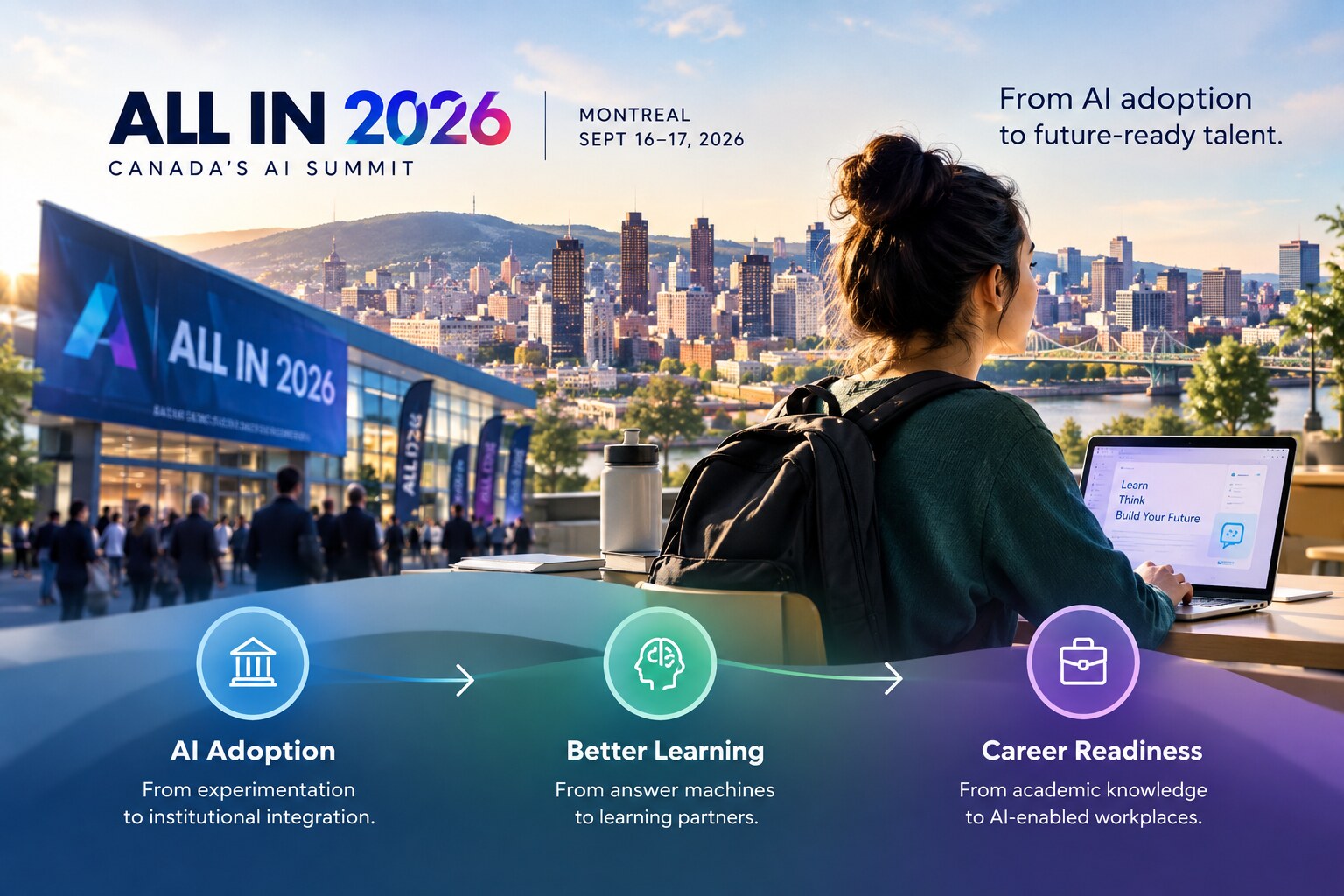
Every mid-September, AI leaders, researchers, investors, and industry pioneers gather in Montreal for ALL IN, Canada’s major AI commercialization event hosted by Scale AI.
This year’s summit, held September 16–17, sent a strong signal: AI is moving beyond experimentation and proof-of-concept projects toward real-world adoption, integration, and measurable impact.
For higher education, this raises an important question:
If AI is moving out of the lab, what should happen when it enters the classroom?
At BrainStream, three themes stood out to us.
1. From AI Experimentation to Institutional Adoption
Universities have spent the past two years experimenting with general-purpose AI tools. But experimentation is different from institutional adoption.
As AI becomes part of university systems and workflows, the conversation is increasingly about privacy, security, governance, integration, and measurable outcomes.
Universities do not simply need another AI tool. They need technology that can work within existing learning environments, support educators, protect student data, and demonstrate meaningful educational value.
For EdTech companies, this changes the challenge. The question is no longer simply “What can AI do?” but “Can AI work responsibly and effectively in the real world of education?”
2. From Answer Machines to Learning Partners
The rapid development of agentic AI makes another question increasingly important: What role should AI play in learning?
As AI becomes capable of completing more tasks for students, universities will need to rethink academic integrity and the learning process itself.
The goal should not be to use AI simply to make coursework easier.
A learning AI should help students identify what they do not understand, ask the right questions, provide guidance, and help them take the next step—without immediately giving away the answer.
In other words:
The goal is not to eliminate struggle, but to make struggle productive.
This is where we believe educational AI can play a different role from a general-purpose chatbot: not an answer machine, but an interactive learning partner that helps students think, practice, and improve.
3. From Learning Support to Career Readiness
Perhaps the most important shift is what happens beyond the classroom.
As AI becomes embedded in the workplace, universities are not only preparing students to learn with AI. They increasingly need to prepare students to work with AI.
Whether a graduate enters finance, engineering, law, medicine, or another profession, tomorrow’s workforce will need more than generic AI skills.
The emerging model is:
Domain Expertise × AI Collaboration
Students will need strong foundations in their chosen fields, combined with the ability to use AI responsibly and effectively within those professions.
This may also change how universities teach and assess students—from traditional assignments toward more practical projects, discussions, portfolios, and domain-specific applications of AI.
In this sense, the purpose of educational AI is expanding.
It is not only about helping students learn today. It is also about preparing them for the workplace of tomorrow.
What This Means for BrainStream
The conversations at ALL IN 2026 reinforce a direction we believe is increasingly important for higher education.
Powerful educational AI should be human-centric, security-conscious, and professionally empowering.
It should support educators, protect the learning process, and help students build both deep domain knowledge and the ability to collaborate with AI.
AI may be moving out of the lab.
The next challenge is making sure that, when it enters the classroom, it makes learning better—and prepares students for what comes next.