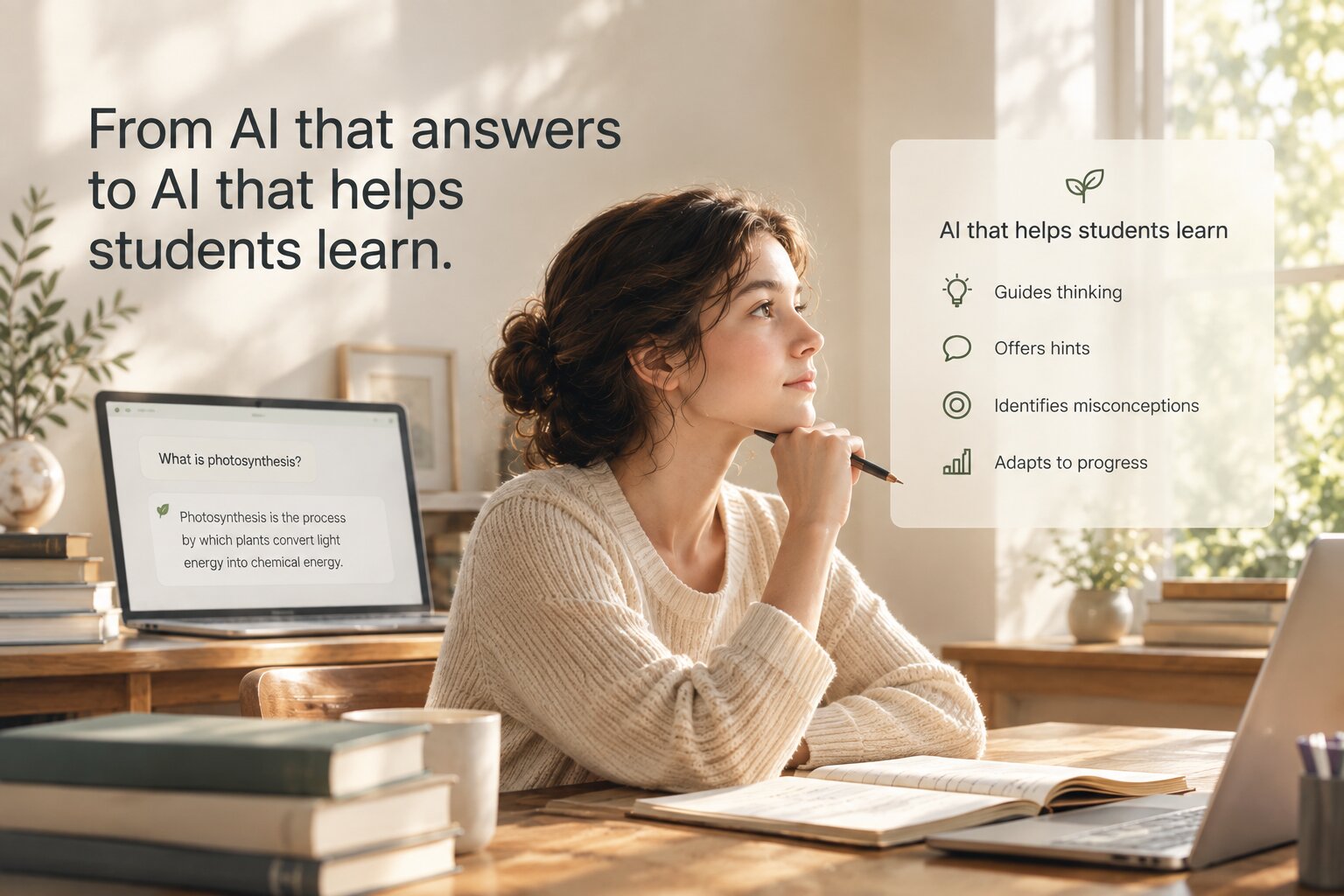
AI in Education: Moving Beyond the ‘Q&A’ Era

by BrainStream Chief Operating Officer Tzu-Ying (Kimberley) Chen
For years, much of the conversation around artificial intelligence in education has focused on a simple question: Can AI answer students’ questions? Increasingly, that is no longer the most important question. As AI becomes more capable and more widely available, attention is shifting toward a deeper challenge: Can AI help students actually learn?
The distinction matters. An AI system can provide a correct explanation, complete a difficult problem, or generate an answer in seconds. Yet completing a task successfully does not necessarily mean that learning has taken place. Education depends not only on access to information, but also on understanding, practice, reflection, and the ability to apply knowledge independently.
This is changing the way AI tutors are being designed. Rather than immediately providing an answer, newer systems are increasingly being developed to ask questions, offer hints, identify misconceptions, and adjust the level of support according to a student’s progress. The goal is not simply to make learning faster, but to encourage students to remain intellectually engaged.
Research is beginning to provide useful evidence. Studies involving AI-supported tutoring have found potential benefits in areas such as learning outcomes, feedback, and instructional consistency. At the same time, the evidence also highlights important limitations. Students do not automatically learn more simply because an AI tutor is available. Excessive assistance can reduce productive struggle, and improved task performance does not always translate into deeper understanding.
This suggests that the next generation of education AI will depend as much on pedagogy as on model capability. A useful AI learning system may need to understand more than the questions in front of it. It may need to understand the curriculum, the learner’s prior knowledge, the mistakes they have made, and the appropriate next step in their learning journey.
This also raises important questions about the role of teachers. AI may provide scalable support, immediate feedback, and additional opportunities for practice, but education remains fundamentally human. Teachers bring context, judgement, encouragement, and an understanding of students that technology cannot fully reproduce.
The direction of the market is therefore not simply toward more powerful AI tutors. It is toward systems that can better connect technology with the process of learning. The most meaningful measure of progress may ultimately be a simple one:
Not whether AI can give students the right answer, but whether students become better at finding, understanding, and applying the answer themselves.