
Navigating Higher Ed’s AI Shift: Agentic Challenges & National Mandates

by BrainStream Chief Financial Officer Phyllis Chia-Hua Chen
As artificial intelligence rapidly reshapes higher education across North America, the last few weeks have marked a critical turning point. The focus has swiftly transitioned from initial curiosity and basic policy-making to addressing sophisticated operational challenges and executing large-scale, national AI strategies.
At BrainStream, we closely track these developments to ensure our platform aligns with the evolving needs of institutions, educators, and students. Here are two defining trends currently transforming the higher education landscape in the U.S. and Canada:
1. The Shift to Agentic AI & The Re-imagining of Academic Integrity
The academic integrity debate is no longer just about students using ChatGPT to generate essay drafts. Higher education IT departments in the U.S. are now confronting the rise of Agentic AI—autonomous tools capable of taking independent multi-step actions.
Equipped with student credentials, these agents can autonomously log into Learning Management Systems (LMS) like Canvas, track deadlines, digest course material, submit assignments, and post on discussion boards. Because these tools mimic real user sessions, traditional AI text detectors are rendered largely obsolete.
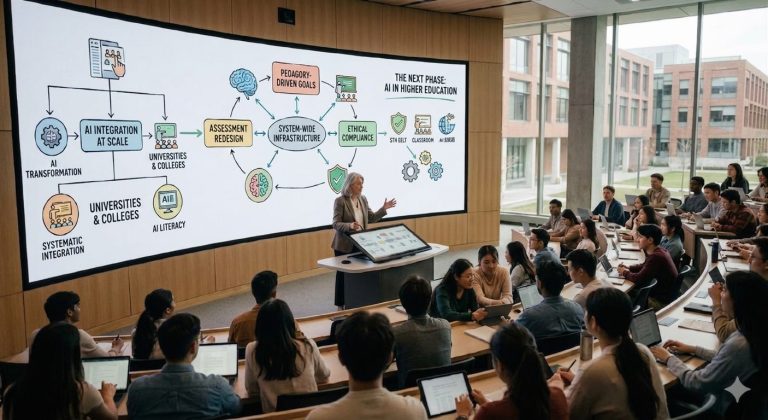
This technological shift is forcing universities to move beyond content-detection tools and re-examine the core of learning itself. Institutions are pivoting toward identity security, behavioral analysis, and most importantly, assessment redesign—favoring oral exams, process-oriented portfolios, and authentic practical evaluations over traditional take-home assignments.
2. Canada’s $2B+ “AI for All” National Strategy: A Blueprint for Safe AI
On the policy front, Canada officially launched its national strategy, “AI for All.” While the policy aims for massive economic growth, its strongest pillar lies directly within post-secondary education.
Key higher education highlights of the strategy include:
- Empowering 1 Million Students: Rolling out structured AI literacy programs and providing custom, Trusted AI Agents for over one million post-secondary students across humanities, business, STEM, and medicine.
- Educator Support: Delivering dedicated AI learning toolkits to over 3,000 educators to assist with course design and classroom engagement.
- Safe by Design: Emphasizing sovereignty, privacy, and safety, ensuring AI tools act as patient, ethical tutors rather than shortcuts.
BrainStream’s Vision
These developments reinforce our core principles at BrainStream. We believe AI should never be used to bypass genuine learning, nor should it replace human educators. Instead, AI must serve as a secure, human-centered partner—a supportive tutor for students and an empowering assistant for teachers.
As higher education transforms its assessment models and governments invest in safe, accessible AI, BrainStream remains committed to building trusted, compliant, and impactful learning experiences for the global educational community.
References & Sources
- EdTech Magazine (June 2026): “What Can Higher Ed IT Do About the Agentic AI Cheating Crisis?”
- Futurism / NYT Coverage (August 2026): “College Kids Are Using AI Agents to ‘Take’ Entire Online Classes for Them”
- Innovation, Science and Economic Development Canada (ISED) (June 2026): “Canada’s National Artificial Intelligence Strategy: AI for All”
- CBC News (June 2026): “Carney’s AI strategy promises over $2B in funding, aims to create 250,000 jobs”
- EDUCAUSE Research (2026): “Assessment Redesign and Identity Management in the Era of Autonomous AI”