
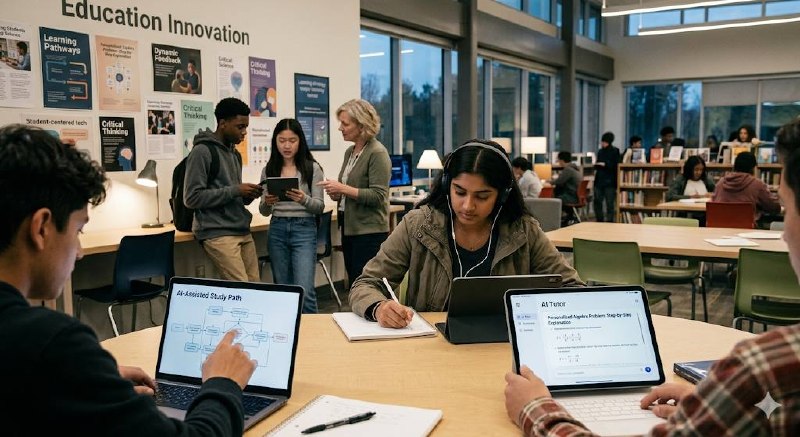
AI Tutors Are Redefining How We Learn: A Turning Point for EdTech

by BrainStream Chief Marketing Officer Ya-Hui (Laura) Kao
A recent study from Stanford Law School has drawn significant attention across the education and technology sectors. In a blind evaluation, professors were asked to assess teaching responses without knowing whether they were written by humans or AI. In many cases, AI-generated answers were rated as clearer and more helpful, with a preference rate reaching 75%.
https://news.stanford.edu/stories/2026/06/ai-law-legal-professors-study
This is not just a signal of technological progress. It reflects a deeper structural shift in how learning itself is being defined.
Learning is Becoming More Immediate and Personalized
Traditionally, learning has been structured around the teacher as the central source of knowledge.
That model is now being reshaped.
With AI tutors, students can receive instant explanations, examples, and alternative breakdowns of the same concept. Learning is no longer bound by classroom pace or availability.
The focus is shifting from being taught to understanding in real time.
The Competitive Focus in EdTech is Changing
As AI tutors become more widely adopted, the core value of education technology is shifting from content delivery to system intelligence.
What matters now is no longer just what content is provided, but:
Whether the system understands learner proficiency
Whether learning paths can adapt dynamically
Whether feedback is immediate and contextual
The competition is moving toward learning intelligence, not just learning content.
AI Will Not Replace Teachers, but It Will Redefine Roles
A growing consensus is emerging in education:
AI handles real-time explanations, practice support, and repetition.
Teachers focus on guidance, critical thinking, and learning strategy.
This is not replacement. It is role redistribution.
Conclusion
The rise of AI tutors represents more than a product evolution. It signals a shift in the architecture of education itself.
Education is moving from content delivery to learning system design.
And this shift reframes the fundamental question for EdTech companies:
It is no longer about who produces the best content.
It is about who can design the most effective learning experience.
The next phase of competition will not be defined by better AI tools, but by who can seamlessly integrate AI into the learning journey, not as an add-on, but as the core system.


