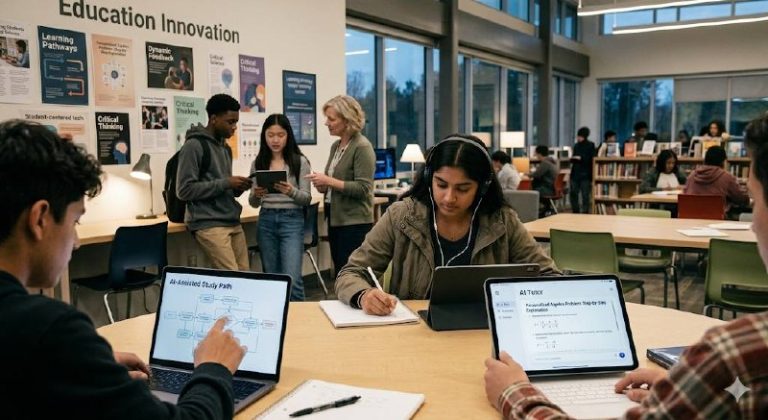
Every Student Deserves a Private Tutor. AI Finally Makes That Possible.
In 1984, educational psychologist Benjamin Bloom published a study that haunted education for 40 years. Students who received one-on-one tutoring performed two standard deviations above those in conventional classrooms. In plain terms: a student at the 50th percentile, given a personal tutor, outperformed 98% of their traditionally taught peers.
Bloom called it the 2-sigma problem: how do you deliver the benefits of private tutoring at the scale of a classroom?
For four decades, the answer was: you can’t.
Mackenzie Morehead’s recent essay for Compound VC lays out why the edtech industry still hasn’t cracked this, even with large language models staring them in the face. It’s a sharp piece, and Morehead diagnoses the core failure with precision: the products built to solve the tutoring gap feel like “a textbook that grades itself.” The pedagogical engine may be clever. The experience is dead.
We agree with nearly everything in the essay. But we think Morehead’s blind spot is the same one afflicting the rest of Silicon Valley: the assumption that solving the tutoring gap requires building something new from scratch.
It doesn’t. It requires giving the right tools to the teachers who already know how to teach.
The VC Version vs. the Real Version
Morehead envisions a future of AI-generated immersive history lessons, GTA-quality educational games, brain-computer interfaces that detect “aha moments,” and simulated student agent personas trained on millions of interactions.
Some of those ideas will happen eventually. Most of them are 5-10 years away, optimistic. And the people who need better teaching tools need them now.
Here’s what we’ve learned from 25 years of teaching 100,000 students across 4 platforms: the tutoring effect doesn’t come from fancy technology. It comes from a teacher who knows the student, responds to what the student actually needs, and adapts in real time. The technology just has to get out of the way.
That’s what a good private tutor does. And that’s exactly what AI can do right now, today, for every teacher who wants it.
What EdTech Gets Wrong
Morehead documents the standard edtech playbook: build a deterministic question-routing system, apply spaced repetition, serve it through a static interface, and hope students don’t quit. ASSISTments achieved effect sizes of 0.18-0.29 standard deviations in randomized trials with 2,800 students. Respectable. Also roughly half of what a mediocre human tutor produces.
The reason is obvious to anyone who has ever actually taught: routing someone through a flowchart of questions isn’t tutoring. Tutoring is noticing that a student freezes every time you mention “point of view” and realizing they’ve confused it with “voice.” Tutoring is hearing the hesitation in someone’s answer and knowing the difference between confusion and lack of confidence. Tutoring is telling a joke about unreliable narrators when you can see a student’s eyes glazing over.
No question-routing algorithm does that. But an AI partner sitting alongside a human teacher can.
BrainStream’s Approach
At BrainStream, we’re building something different from what Morehead describes. We aren’t trying to replace teachers with AI tutors. We’re giving teachers AI partners that multiply their reach.
Consider what happens when a writing teacher gets an AI assistant that can:
- Read a student’s draft and identify the 3 specific craft problems worth discussing (not the 47 surface-level grammar issues that don’t matter yet)
- Remember that this particular student struggles with dialogue attribution and frame feedback around that pattern
- Generate a targeted exercise based on the student’s own manuscript, not a generic worksheet
- Handle the 80% of student questions that have straightforward answers, freeing the teacher for the 20% that require human judgment
The teacher still teaches. The AI handles the scale problem that makes one-on-one attention impossible in a class of 30.
Modern studies back this up. Research from Eedi and Google DeepMind found that human-in-the-loop AI tutoring outperforms human-only support. The best results don’t come from AI alone or humans alone. They come from the combination.
Bloom Was Right. So Is Morehead. But the Solution Is Simpler Than Either Expected.
The tutoring gap was never really a technology problem. It was a ratio problem: one teacher per 30 students means 29 students aren’t getting individual attention at any given moment.
AI doesn’t need to become a superhuman tutor to fix that ratio. It needs to become a capable teaching assistant, handling the routine work so that human teachers can do what only humans can do: notice, empathize, inspire, and adapt.
That technology exists today. We’re building it at BrainStream.
The gap won’t close because someone builds a perfect AI tutor in a vacuum. It’ll close because millions of teachers get AI partners that make one-on-one attention possible at classroom scale.
The VCs can keep funding immersive history simulations. We’ll be here, working with the teachers.