The AI Reality Check in Higher Ed: Insights from 45,000 Students and Faculty

by BrainStream Chief Financial Officer Phyllis Chia-Hua Chen
AI has entered university campuses faster than most institutions could prepare for. But widespread adoption does not necessarily mean meaningful educational impact.
The Digital Education Council’s AI in Higher Education Global Survey 2026, based on 45,398 responses from students and faculty across 35 countries, reveals a growing gap between how quickly AI is being adopted and how effectively it is being integrated into education.
Students and faculty recognize AI’s potential to improve productivity, but they also have concerns about independent thinking, academic fairness, and whether today’s education is preparing students for an AI-enabled workplace.
Here are four findings that deserve closer attention.
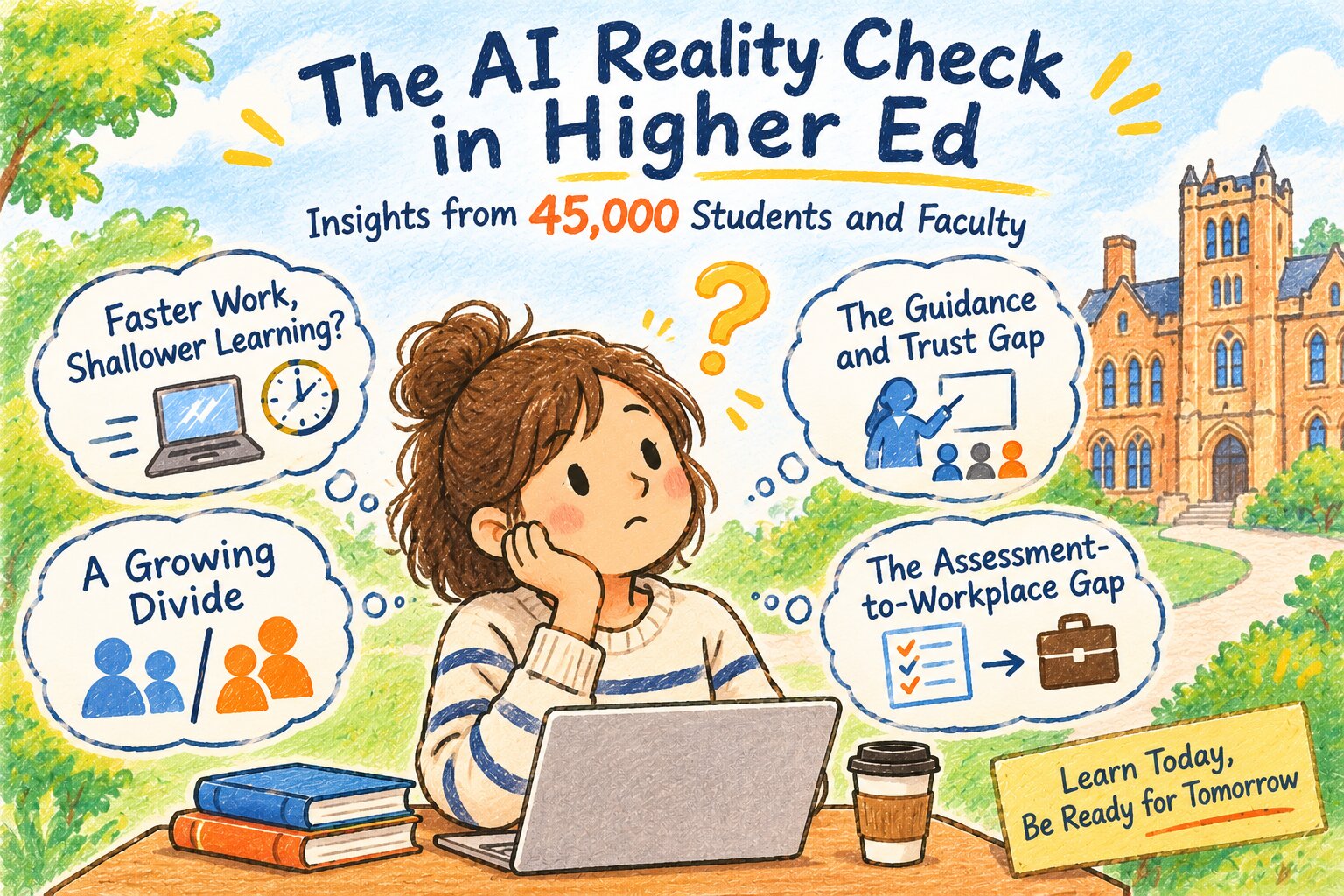
1. Faster Work, Shallower Learning?
Students clearly see the productivity benefits of AI. 61% say it frees them up to focus more on big-picture ideas, while 31% say it allows them to take on more challenging tasks.
But there is another side to this progress. Roughly two-thirds of students (66%) and 73% of faculty worry that relying on AI could lead to shallower learning and weaken independent thinking skills.
This highlights an important tension: completing a task more efficiently does not necessarily mean learning more from it. If AI consistently does the thinking for students, they may finish assignments faster without developing the reasoning and problem-solving abilities those assignments are meant to build.
The challenge is not simply to make AI more capable, but to make sure students remain actively involved in the learning process.
2. A Growing Divide in North America
Attitudes toward AI in higher education vary significantly across regions.
While faculty in Asia-Pacific remain relatively optimistic about AI’s potential, educators in the US and Canada are becoming more cautious. Faculty intent to use AI in teaching in North America declined from 76% in 2025 to 67% in 2026. Meanwhile, 55% of North American faculty believe AI poses a serious risk to human intellectual development.
Students share some of these concerns. 43% of students in the US and Canada say they would support an institution-wide AI ban. In addition, 73% worry that classmates may use AI unfairly to gain an academic advantage.
These findings suggest that the debate is about more than whether AI should be allowed on campus. Students and educators also want to know whether its use is fair, transparent, and consistent with the purpose of education.
Without clear expectations, AI can become a source of uncertainty and mistrust rather than a useful learning resource.
3. The Guidance and Trust Gap
Another significant finding is the gap between faculty training and students’ confidence in their instructors’ ability to guide AI use.
Although 64% of faculty globally have participated in AI literacy training, only 29% of students believe their instructors are well equipped to guide them on using AI. In the US and Canada, that figure falls to just 17%.
Training alone does not automatically translate into effective classroom guidance. Students need more than general explanations of what AI can do. They need clear direction on when and how to use it, how to evaluate its output, and where independent work and judgment remain essential.
When expectations are unclear, students are left to navigate these boundaries on their own. This can create confusion around academic integrity and make responsible AI use harder to establish.
4. The Assessment-to-Workplace Gap
Perhaps one of the most important findings concerns the disconnect between university assessments and the skills students will need after graduation.
Only 28% of students feel that most or many of their current assessments reflect the work, skills, and judgment required in an AI-enabled workplace. In other words, most students do not consistently see a connection between how they are evaluated at university and what they expect to encounter in their future careers.
There is also a difference in perspective between students and faculty. In the US and Canada, 58% of faculty say they are not worried that their teaching materials will become outdated by the time students graduate.
This contrast raises an important question: if AI is changing how work gets done, are universities adapting their teaching and assessment methods quickly enough?
Knowing how to use AI is only part of the equation. Future professionals will also need strong subject knowledge, critical judgment, problem-solving skills, and the ability to work effectively with AI tools. These capabilities are difficult to measure through assessments that focus primarily on producing the right answer.
Universities may need to place greater emphasis on practical projects, discussion, applied problem-solving, and assessments that reveal how students think—not just what they submit.
What This Means for the Future of Learning
The survey points to a challenge that goes beyond whether universities should embrace or restrict AI. The more important question is whether students are developing the skills to use AI thoughtfully—and to know when not to rely on it.
For those of us building educational technology, this distinction matters. The value of an AI learning tool should not be measured simply by how quickly it delivers an answer or helps students complete a task. It should be measured by what students can understand, question, and apply after using it.
At BrainStream, this is the direction we believe educational AI should take: helping students build strong subject knowledge, develop independent judgment, and learn to collaborate with AI in ways that prepare them for the workplace.
The goal is not to make learning effortless, but to make it more meaningful and relevant.
Source: Digital Education Council (2026). AI in Higher Education Global Survey 2026. Based on 45,398 responses across 35 countries.