Beyond Answers: AI That Helps Students Learn

by BrainStream Chief Operating Officer Tzu-Ying (Kimberley) Chen
Artificial intelligence has made information easier to access than ever before. Students can ask questions, receive explanations, and explore unfamiliar topics within seconds. Yet, in education, a quick answer is not the same as meaningful learning.
The next stage of educational AI should be measured not by how many questions it can answer, but by how well it helps students understand concepts, recognise gaps in their knowledge, and develop the ability to learn independently.
Beyond the Right Answer
Recent research highlights why this distinction matters.
A 2026 randomised controlled trial by researchers at the University of Maryland examined a course-integrated AI tutor involving 2,379 undergraduate students and 30 instructors. Students given access to the tutor achieved lower final grades and engaged less with existing course materials than students in comparison classes. The researchers cautioned that the findings do not show that all AI tutoring tools are ineffective. Rather, they raise important questions about how students use AI and how it affects their wider learning habits.
Other research offers a more encouraging picture. A 2026 study published in The Journal of Economic Education found that students using a course-specific AI tutor performed better on exams than those studying without AI. The strongest results came when AI-supported learning was combined with group discussion.
Taken together, these findings suggest that AI does not improve learning simply by being available. Its value depends on how it is used and the learning experience built around it.
Read the University of Maryland study | Read the study on AI tutoring and group learning
Making Learning Visible
Every student learns at a different pace. Some understand a concept but struggle to apply it. Others need to revisit earlier ideas before moving forward.
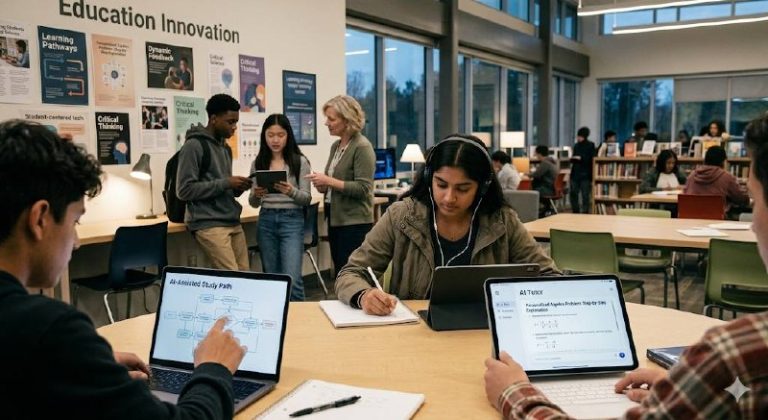
Well-designed educational AI can help identify these gaps through questions, practice, and feedback. When connected to course materials, it can guide students back to relevant topics and help them build understanding step by step. It can also give teachers useful insight into where further support may be needed.
Building Independent Learners
The purpose of education extends beyond completing today’s tasks. Students need to develop the confidence and ability to think, question, and apply knowledge in new situations. Educational AI should support this process, not replace it. The goal is to help students move from receiving explanations to forming their own understanding, and from relying on answers to learning how to find them.
As the technology develops, its success should be judged by more than speed, convenience, or usage. The more meaningful measure is whether students become more capable, confident, and independent learners.
The future of educational AI is not simply about giving better answers. It is about helping students become better learners.