
The Tale of Two Provinces: How Ontario and BC are Redefining AI Equity in Higher Ed 🇨🇦

by BrainStream Chief Financial Officer Phyllis Chia-Hua Chen
When we discuss Canada’s new federal “AI for All” initiative (covered by our CEO here: Canada Bets on Education—and So Do We), the real challenge isn’t the national vision—it’s the provincial execution. Looking at Canada’s two most populous provinces, Ontario and British Columbia, we see two sides of the same coin: a critical systemic warning, and the blueprints for a solution.
As higher education moves past the pilot stage and enters “Integration at Scale,” the financial and infrastructural divide between top-tier research universities and smaller regional colleges has become the industry’s biggest hurdle.
Here is how Ontario and BC are shaping the future of educational technology market dynamics today:
⚠️ Ontario’s Warning: The Capital Barrier and the “AI Divide”
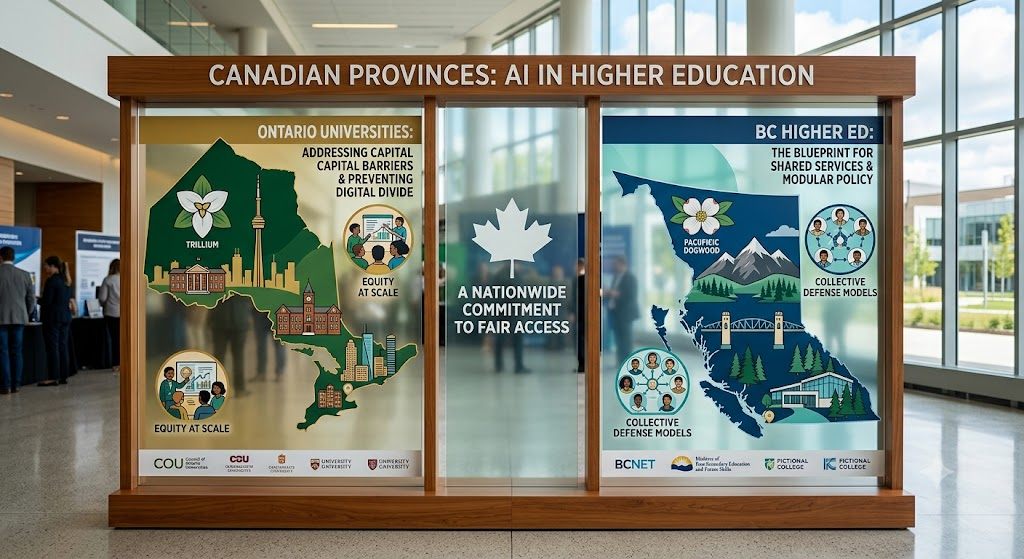
The Council of Ontario Universities (COU) recently released a stark warning in their whitepaper, Charting a Path Forward for Ontario Universities in the Age of AI. While elite institutions have the budgets to build secure, proprietary AI systems, mid-sized and smaller universities are facing an existential funding crisis. The upfront capital expenditure for enterprise-grade data privacy (FERPA/GDPR), cybersecurity, and continuous faculty training is cost-prohibitive for smaller schools. Without intervention, we risk creating a permanent class system in student AI access.
💡 BC’s Blueprint: Shared Services and Modular Policy
Meanwhile, on the West Coast, British Columbia is showing the market how to fight back through collective infrastructure. Through BCNET (the province’s higher ed digital infrastructure consortium) and direct guidance from the Ministry of Post-Secondary Education and Future Skills, BC is actively deploying a collaborative defense:
- Modular Policy Guidelines: The province issued a unified AI policy framework, saving smaller schools the massive legal and administrative costs of drafting compliance guidelines from scratch.
- Shared Infrastructure Models: Rather than forcing schools to purchase isolated software, BC is leveraging collective purchasing and shared cloud networks so that smaller community colleges ride the same enterprise-grade security “wave” as top-tier research institutions.
Accompanying Artwork: Provincial AI Dynamics in Canada
🎯 The Market Reality
The message from Canada’s economic engines is clear: The future of EdTech is not about building isolated point solutions; it’s about enabling Shared Service Models. This is the exact thesis behind Brainstream. We didn’t just build another AI feature; we engineered a scalable, enterprise-grade AI infrastructure designed for collective deployment and seamless institutional integration. Our mission is to ensure that a student at a regional college has the exact same secure, advanced learning advantages as one at a top-tier university.
True innovation isn’t just about making AI smarter—it’s about breaking down the capital walls so that educational equity is accessible to all, regardless of the size of an institution’s budget.