International AI Education Trends: Observations from a Global Perspective

by BrainStream Chief Operating Officer Tzu-Ying (Kimberley) Chen
The global education sector is entering a new phase of AI adoption. Across North America, Europe, Asia, and Oceania, educational institutions are moving beyond experimentation and beginning to explore how AI can be integrated into teaching, learning, and school operations in practical and sustainable ways.
While approaches differ across countries and regions, several common trends are emerging.
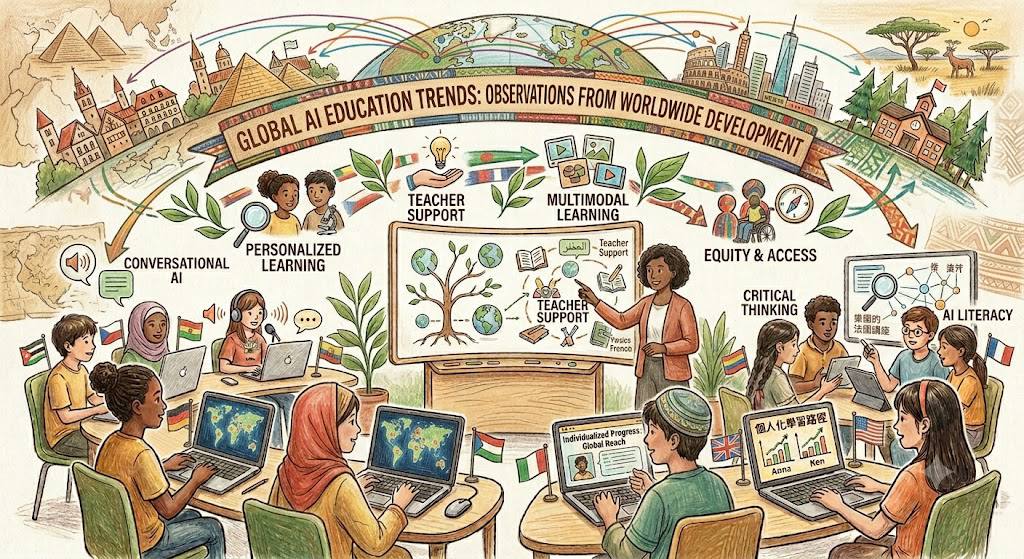
One of the most visible developments is the growing interest in personalized learning. As student populations become increasingly diverse, educators are looking for ways to better support individual learning needs, abilities, and learning pace. AI technologies are being explored as a means of providing more tailored learning experiences and timely feedback, helping institutions address challenges that are difficult to solve through traditional one-size-fits-all approaches.
Another notable trend is the evolving role of AI as a tool that supports educators. Rather than focusing on replacing teachers, many schools are investigating how AI can assist with lesson planning, content development, assessment creation, and administrative tasks. In many cases, the objective is to reduce routine workloads and allow educators to spend more time on instruction, student engagement, and relationship-building.
The rise of multimodal learning experiences is also influencing educational practice. Advances in voice, image, and conversational AI are creating new ways for students to interact with learning content. These technologies have the potential to support accessibility, encourage engagement, and accommodate a wider range of learning preferences and educational contexts.
At the same time, AI literacy is becoming an increasingly important area of focus. Around the world, educational institutions are recognizing that students will need more than the ability to use AI tools. Understanding how AI systems function, recognizing their limitations, and evaluating AI-generated information critically are emerging as important skills for both academic and professional environments.
A further area of discussion is equity and access. Policymakers, educators, and technology providers are examining how AI might help expand educational opportunities for learners from different geographic, linguistic, and socioeconomic backgrounds. While challenges related to infrastructure, access, and implementation remain, there is growing interest in the potential of AI to support broader participation in high-quality learning experiences.
Taken together, these developments suggest that the future of AI in education will be shaped not only by advances in technology, but also by the decisions institutions make regarding implementation, governance, and educational priorities. As adoption continues to evolve, the focus appears to be shifting toward finding balanced approaches that enhance learning outcomes while maintaining the essential human elements of education. The coming years will likely provide valuable insights into how different education systems adapt to these changes and how AI can best support learners and educators in an increasingly connected world.