
Smarter Databases: Using AI for Security and Maintenance

by BrainStream Chief User Experience Officer Yung-Wen Cheng
A reliable student database is essential to BrainStream. It must organize student profiles, course enrollments, assessment results, and learning progress while ensuring that sensitive information remains accurate and protected. AI can make database development and maintenance more efficient, but its benefits depend on a well-designed structure and strong security controls.
Building a Well-Structured Database
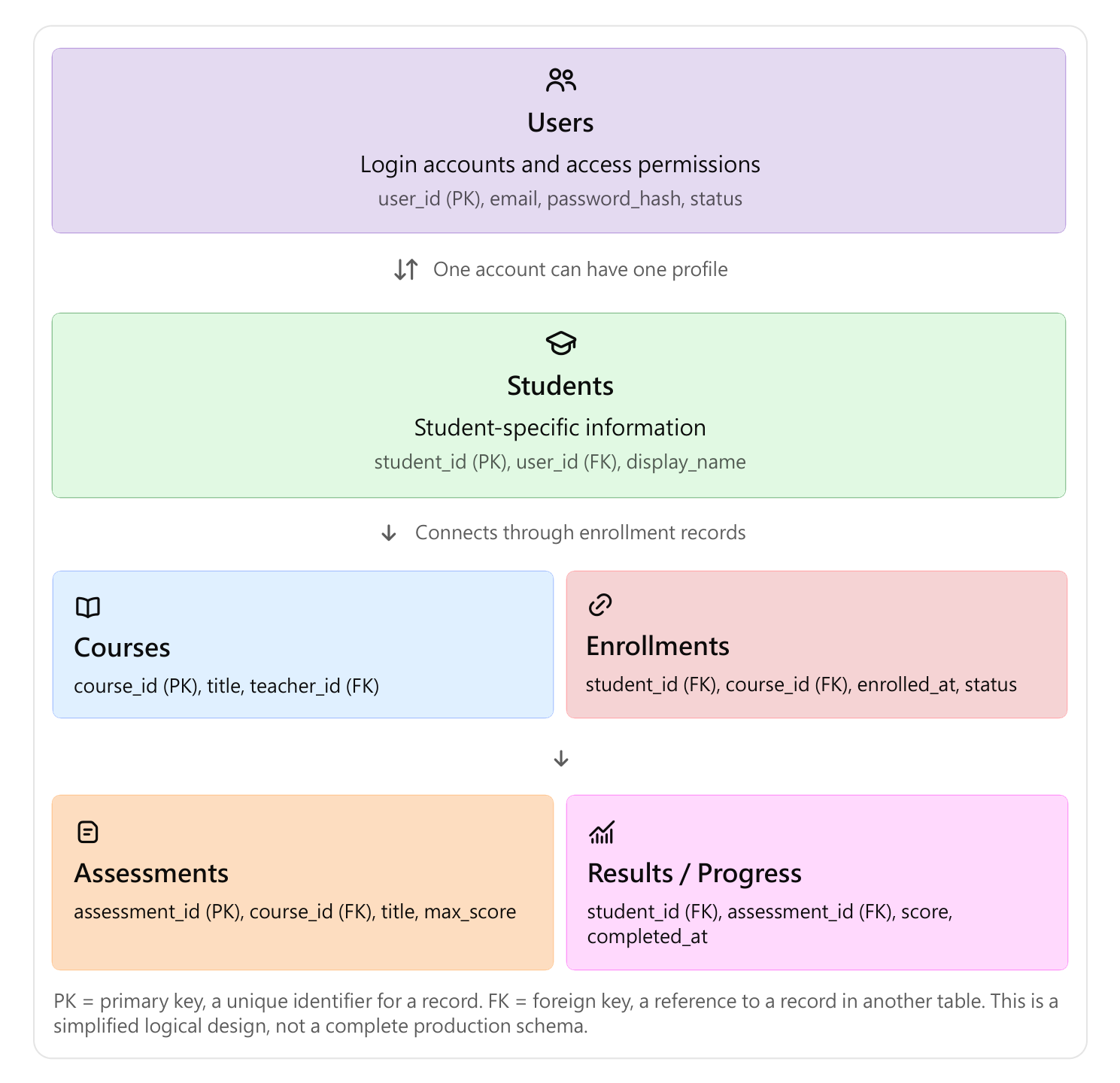
A relational database is a practical starting point for BrainStream. Instead of storing everything in one large table, information can be divided into related tables such as Students, Courses, Enrollments, Assessments, Learning Progress, and User Permissions. Primary keys and foreign keys connect these records, reducing duplication and helping maintain data consistency.
For example, a student should have one unique student ID that connects their course enrollments and progress records. Personal information should be collected only when necessary, and access to identity details should be separated from general learning analytics whenever practical. Structuring the student database around one central idea: keep student identity, course information, learning activity, and permissions in separate but connected tables. This makes the database easier to maintain, safer to access, and more flexible as the app grows.
Below is a diagram that shows the main relationships. In a real implementation, the database would also include tables for teachers, organizations or schools, course materials, learning activities, permissions, and audit logs.
AI can assist us by suggesting database schemas, identifying duplicated fields, generating SQL queries, and helping plan data migrations. However, we must also review these suggestions to ensure that relationships, constraints, and permissions are correct.
How AI Can Improve Security and Maintenance
AI can help monitor database activity and identify unusual patterns, such as repeated failed logins, unexpected bulk downloads, or access to student records outside normal working patterns. It can also flag inconsistent records, detect possible duplicates, summarize system logs, and recommend maintenance tasks.
These capabilities are particularly useful as BrainStream grows. Instead of relying entirely on manual checks, we can use automated alerts to prioritize suspicious activity and identify data-quality problems earlier.
However, AI should support security rather than replace established safeguards. Encryption, multi-factor authentication, role-based access control, secure backups, software updates, and audit logs remain essential. Destructive actions, such as deleting records or modifying permissions, should require clear rules and appropriate human approval.
Benefits and Risks
AI can reduce repetitive work, speed up development, improve monitoring, and help small development teams maintain databases more consistently. The main disadvantages are inaccurate recommendations, false security alerts, additional infrastructure costs, and the possibility that an AI tool could expose sensitive information if data is sent to an external service. AI-generated database changes may also introduce vulnerabilities if they are not tested.
Recent events demonstrate why these precautions matter. In June 2026, the UK Information Commissioner’s Office reported findings from audits of 28 educational technology providers, including problems involving data minimization, retention policies, and data-flow documentation. In the United States, the Federal Trade Commission finalized an order concerning Illuminate Education following allegations that security failures contributed to a breach affecting approximately 10.1 million students. These examples show that protecting student data requires sound processes, not simply new technology.
A Practical Approach for BrainStream
BrainStream can use AI to assist with schema design, data validation, anomaly detection, and routine maintenance while keeping database access tightly controlled. AI services should not receive identifiable student data unless the service has been properly assessed and approved for that purpose.
Ultimately, the strongest approach combines a well-structured database, established security practices, automated monitoring, and human oversight. AI can make a student database easier to build and maintain, but privacy and security must remain design requirements from the beginning.
Sources:
UK Information Commissioner’s Office: Edtech examined report statement, June 2026
U.S. Federal Trade Commission: Final order concerning Illuminate Education, June 2026